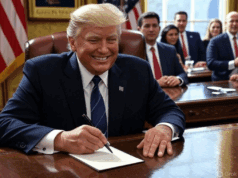















President Donald Trump has notched a major win as the Republican-controlled U.S. House of Representatives passed a sweeping $9 billion funding cut to public media and foreign aid, sending the legislation to the White House for his signature. Reported earlier this week and finalized early Friday, July 18, 2025, at 10:54 AM BST, this bold move has ignited a fiery debate over government spending priorities as the nation navigates a pivotal year.
The vote, narrowly approved at 216-213, reflects a rare display of party unity despite internal House squabbles, particularly over the contentious Jeffrey Epstein case. As public sentiment on social media swirls with mixed reactions—ranging from applause for fiscal restraint to worries about public broadcasting cuts—this article dives into the details, implications, and what’s next for this game-changing decision.
How President Trump’s $9 Billion Funding Cut Victory Unfolds in 2025
The passage of this $9 billion rescissions package marks a significant shift in U.S. fiscal policy, aligning with Trump’s aggressive push to trim what he deems wasteful spending. The legislation targets $8 billion in foreign aid programs and $1.1 billion for the Corporation for Public Broadcasting (CPB), which funds NPR and PBS. This move, driven by the White House and supported by the Department of Government Efficiency under Elon Musk’s former oversight, leverages a rarely used congressional tool to claw back funds already approved. With the Senate’s earlier 51-48 approval and the House’s final nod, the bill now awaits Trump’s signature, a formality expected by the end of Friday under budget rules.
The vote wasn’t without drama. House proceedings were delayed for hours due to infighting among Republicans, fueled by demands for transparency on the Jeffrey Epstein case. Some GOP members, including Speaker Mike Johnson, pushed for a resolution calling for the release of Epstein-related documents within 30 days, a move critics labeled a “glorified press release” for lacking enforcement power. Despite this, party loyalty held, with only Representatives Brian Fitzpatrick of Pennsylvania and Mike Turner of Ohio joining Democrats in opposition. This unity underscores Trump’s influence, even as it highlights the delicate balance within his coalition.
Public and Political Reactions Ignite
Public reaction, found on social media, paints a polarized picture. Supporters hail the cuts as a step toward fiscal sanity, with posts praising Trump’s “America First” agenda and the redirection of funds to domestic priorities. Others, however, express alarm over the impact on public media, noting that rural stations reliant on CPB funding could face closures, disrupting emergency alerts and educational programming. These views, while inconclusive due to the fluid nature of online discourse, reflect a broader tension between cost-cutting and public service preservation.
Democrats, led by House Minority Leader Hakeem Jeffries, have decried the cuts as “cruelty” that undermines national security and soft power globally. Advocacy groups like Oxfam America warn of dire consequences for the world’s poorest, citing potential losses in food security and health programs. Yet, Republicans, including Representative Aaron Bean of Florida, frame it as a “giant leap toward fiscal responsibility,” urging monthly similar actions. This clash sets the stage for a contentious 2025 budget battle, with the $9 billion—less than 0.1% of the $6.8 trillion federal budget—serving as a litmus test for future cuts.
The Epstein Case Connection
The Jeffrey Epstein case added an unexpected layer to the debate. House Republicans’ insistence on addressing Epstein files, amid Trump’s dismissal of the issue as a “hoax,” delayed the vote and exposed party fractures. Attorney General Pam Bondi’s directive to seek grand jury testimony release, following a Wall Street Journal report alleging a 2003 letter from Trump to Epstein, has further fuelled speculation. Trump’s base, including far-right voices, demands transparency, while the White House seeks to pivot focus to economic priorities. This subplot, inconclusive in its resolution, underscores the political tightrope Trump navigates.
Economic and Global Implications
Economically, the cuts signal a shift toward domestic investment, aligning with Trump’s campaign promises. The removal of a proposed $400 million cut to the President’s Emergency Plan for AIDS Relief (PEPFAR) after Senate negotiations shows some flexibility, preserving a program credited with saving millions of lives. However, the broader $8 billion foreign aid reduction could strain U.S. alliances, particularly with nations like Jordan and Egypt, where aid supports stability. Critics argue this risks America’s global standing, while proponents see it as reallocating resources to address domestic inflation and job growth—key 2025 voter concerns.
Public broadcasting faces an uncertain future. With federal funding comprising 8-10% of NPR and PBS station budgets, the $1.1 billion cut threatens local operations, especially in rural areas. NPR CEO Katherine Maher has warned of risks to public safety alerts, a point echoed by Alaska Senator Lisa Murkowski, who voted against the bill citing tsunami warning reliance. Yet, Trump’s social media posts celebrate the move, calling public media “atrocious” and vowing more cuts, resonating with his base’s view of liberal bias.
What’s Next for 2025 Spending?
This victory emboldens Trump’s administration to pursue additional rescissions, with OMB Director Russ Vought hinting at further targets. The House’s approval, despite Epstein-related delays, suggests Congress may continue deferring to executive spending wishes, challenging its constitutional “power of the purse.” Senate holdouts like Susan Collins and Murkowski signal potential resistance, but the simple majority requirement favors Republican control.
For the public, the debate’s outcome will shape access to news, education, and global aid. As 2025 unfolds, this $9 billion cut could set a precedent for broader fiscal policy, influencing midterm election narratives. Stay tuned as the White House ceremony to sign this bill, potentially Friday afternoon, draws near—offering a glimpse into Trump’s next moves.
Engaging with the Debate
Whether you’re a taxpayer cheering fiscal discipline or a media supporter worried about local stations, your voice matters. Engage on social platforms, follow updates from sources like The New York Times or Reuters, and watch for congressional responses. The Epstein case’s unresolved threads may also resurface, keeping this story dynamic. At 10:54 AM BST today, the conversation is just heating up—don’t miss out!
Visit www.iwerenews.com for more trending news.